https://buy-zithromax.online buy kamagra usa https://antibiotics.top buy stromectol online https://deutschland-doxycycline.com https://ivermectin-apotheke.com kaufen cialis https://2-pharmaceuticals.com buy antibiotics online Online Pharmacy vermectin apotheke buy stromectol europe buy zithromax online https://kaufen-cialis.com levitra usa https://stromectol-apotheke.com buy doxycycline online https://buy-ivermectin.online https://stromectol-europe.com stromectol apotheke https://buyamoxil24x7.online deutschland doxycycline https://buy-stromectol.online https://doxycycline365.online https://levitra-usa.com buy ivermectin online buy amoxil online https://buykamagrausa.net

Gender Selection

So we’re probably going to be getting a new cat — probably this weekend — as Katherine has had a yen for a pet, and she’s demonstrated she can be…

So we’re probably going to be getting a new cat — probably this weekend — as Katherine has had a yen for a pet, and she’s demonstrated she can be responsible, and I (or we, but Margie keeps saying it’s me) am a marshmallow.

Katherine’s initial preference, actually, is for something — fish, guinea pigs, hamsters, etc. — that our current cats would consider as “food,” which would be unfair to the newcomers and present incumbents alike. Cats are also a solid idea for us because they tend to be pretty independent and easy to care for, and if we’re away for a weekend or something, we aren’t going to come back and find them floating upside down in the tank or the small-rodent equivalent.

Katherine has semi-reluctantly agreed, though she’s still got her hopes up that we’ll change our mind.

So in Margie and my discussions about this outside of little pitcher range, we agreed that a female cat would be best — least competition with Mist and Indy, least likely to mark territory, etc.

As we were discussing this with Katherine on the way to dinner tonight, she piped up, utterly unsolicited, “It has to be a girl kitty!”

Excellent, we thought. One less complication to negotiate with her. “Yes,” Margie said, “we need a girl one.”

Katherine continued, “So we can have kittens and more kittens!”

Ah … that engendered another talk, but I was still chuckling several minutes later …

The Name’s the Thing

The latest goofy meme, this time from Amanda: YOUR SPY NAME: (middle name and current street): Christopher Monaco. YOUR MOVIE STAR NAME: (grandfather/grandmother on your mom’s side, your favorite candy):…

The latest goofy meme, this time from Amanda:

  1. YOUR SPY NAME: (middle name and current street): Christopher Monaco.
  2. YOUR MOVIE STAR NAME: (grandfather/grandmother on your mom’s side, your favorite candy): Mario Roca
  3. YOUR RAP NAME (first initial of first name, first two or three letters of your last name ): D-Hi
  4. YOUR GAMER TAG: (a favorite colour, a favorite animal): Blue Serval
  5. YOUR SOAP OPERA NAME: (middle name, city where you were born*): Christopher Paloalto
  6. YOUR STAR WARS NAME: (first 3 letters of your last name, last 3 letters of mother’s maiden name*, first 3 letters of your pet’s name): Hil Rie Mis
  7. JEDI NAME: (middle name spelled backwards, your mom’s maiden name spelled backwards*): Sirhc Eiram
  8. PORN STAR NAME: (first pet’s name, the street you grew up on): Ginger Silver Spray
  9. HERO NAME: (“The”, your favorite color, the automobile your dad drives): The Cobalt Forerunner

It’s actually uncanny how many of these work. Though #8 is just disturbing. And I now feel compelled to create a CoH character, The Blue Serval.

*Some of this is info that some (not very smart) companies use as identifiers for password access and identify verification. Thus, I have actually used alternatives that are fitting but not security risks.

“Bonk-bonk on the head! Bonk-bonk! Bonk-bonk!”

Ah, for the halcyon days of yore, when Man lived in harmony with nature, the ebb and flow of the seasons, bringing in the harvest , a time of the…

Ah, for the halcyon days of yore, when Man lived in harmony with nature, the ebb and flow of the seasons, bringing in the harvest , a time of the noble savage, one with nature and with each other.

Just kidding. Actually, aside from things like malnutrition and diseases and predators, neolithic Man was pretty freaking brutal to each other.

IF YOU are worried about being attacked or killed by a violent criminal, just be glad you are not living in Neolithic Britain. From 4000 to 3200 BC, Britons had a 1 in 14 chance of being bashed on the head, and a 1 in 50 chance of dying from their injuries.

Grisly figures from the first systematic survey of early Neolithic British skulls reveal that life then was no rural idyll. “It’s certainly more violent than we’d considered,” says Rick Schulting of Queen’s University Belfast, UK, who conducted the study with Mick Wysocki at the University of Central Lancashire in Preston.

They’ve basically done a survey of 350 skulls in Southern England from that era. Most of the injuries are to the left side of the head (where a rock or club or axe wielded left- right-handedly would hit).

Nasty, brutish, and short, as Hobbes described life in the “state of nature.”

(via Collision Detection)

New product plug

title=” src=”https://www.hill-kleerup.org/blog/images/plug_in.jpg” width=”113″ Plug? /> No, literally — a new plug.  Or, rather, a new plug outlet idea, which won a 2006 Industrial Design Excellence Award (for a Student Design)…

<$ALT$> title=” src=”https://www.hill-kleerup.org/blog/images/plug_in.jpg” width=”113″ Plug? /></div><p>No, literally — a new plug.  Or, rather, <a href=a new plug outlet idea, which won a 2006 Industrial Design Excellence Award (for a Student Design) from IDSA.

PLUG-IN addresses the difficulty the elderly can have with electrical outlets. While the market is full of countless flush outlets and child-protection units, none address the unique limitations of the elderly. The PLUG-IN’s upward-angled faceplate allows users to better orient themselves and a cord’s prongs before bending over or reaching behind furniture. This creates a direct sightline from the human eye to the faceplate and minimizes the distance necessary for a person to extend. It
also provides additional leverage when removing of a difficult plug. The PLUG-IN fits onto current outlet standards and is easily installed by the user.

It does stand out slightly from the wall, but not enough to cause problems on unused outlets.  And for stuff behind walls, it actually reduces how far out from the wall normal plugs extend.  It might cause problems (with angling outwards, as well as overall size) for AC adapters, but that’s fairly trivial.

Nice. Developed by Julia Burke at Notre Dame.

(via Collision Detection)

Let it burn, part 2

Okay, this started as a response to Avo’s comment in this thread about flag burning, noting Scott Adams’ address of the issue, but it got long, so, heck, let’s make…

Okay, this started as a response to Avo’s comment in this thread about flag burning, noting Scott Adams’ address of the issue, but it got long, so, heck, let’s make it a blog post.

My favorite quote from Adams:

It seems to me that the great thing about the flag is that it symbolizes something inherently indestructible: the concept of freedom. You can burn the flag as many times as you want and the concept of freedom is not only still there – it’s stronger. I like that about my flag. I would go so far as to say it’s my flag’s best feature.

Me like.

Another point he makes:

If flag burning becomes illegal, someone is going to start a company that sells flags that are slightly different from American flags – just different enough to be legal to burn. The burnable flags might have 51 stars, or 14 stripes – something like that. The beauty of this concept is that if you got caught burning a real American flag, you could claim it was really just a near-flag. That’s reasonable doubt. No one would ever get convicted.

I remember reading someone’s commentary that because the amendment was so specific, there was very little penumbra to worry about (no “well, the courts will also let people be locked up for desecrating something that isn’t an actual honest-to-gosh American flag”). Aside from the remarkable ability for courts (and, more importantly, law enforcement) to find penumbrae wherever they wish, the flip side to that is just what Adams notes: people will simply burn something that is just as evocative and distressing, but just outside the bounds of the law. Effigies of the President, or of the Statue of Liberty, or copies of the Constitution, or state flags, or a flag with one big white star. If they’re shouting, “Die, Amerikka!” and “Amerikkka is a bunch of poopyheads,” you can’t tell me folks won’t be just as upset.

(I’ll also be waiting to for the first case where an editorial cartoonist who uses a flag in a cartoon that is critical of a governmental action gets hauled into court for it. Even if the case is lost, the chilling effect will be profound.)

Adams also nicely (though not uniquely) lampoons Frist’s comments about the flag being a “national monument,” and how we don’t let folks destroy Mt Rushmore or the Washington Monument.

No, we don’t. But (my observation) if they buy a replica of the Washington Monument at a gift store, there’s no law that prevents them from smashing that replica with a hammer. The point being that the symbol is not the reality (unless we’re talking magic here, or idolatry). A model of the Washington Monument is not the real thing. An effigy or drawing or photograph of George Bush is not the real thing. And the US flag, as a symbol of our nation, its freedoms, and its principles, is not the real thing.

Burning a flag doesn’t cause the entire nation to combust in some huge inferno of sympathetic magic. Nor does it actually harm our freedoms or our principles. It makes people angry, yes, and disgusted and irked and hurt and sad and whatever. So do a lot of things. So does losing a ball game. So does losing a job. So does hearing someone say [insert racial, sexual, religious epithet of your choice]. So does [fill in the politician, pundit, and/or celebrity of your choice] spouting off their typical nonsense. Those things are not, however, illegal per se.

Flag burning amendments are voo-doo idolatry at best, cynical political manipulation of the populace at worst.

Doused

With the new public places smoking law going into effect here in Colorado, things are a-changing at the office. An e-mail from our Ops Manager here: Initially, and in order…

With the new public places smoking law going into effect here in Colorado, things are a-changing at the office. An e-mail from our Ops Manager here:

Initially, and in order to strictly comply with this law, effective 1 July, smoking is not permitted within 25 feet of all 4 normal building entrances. To emphasize this, [office manager] will also be moving all ashtrays to further than 25 feet from entrances, and expedite our landlord to post no smoking signs identical to those currently posted at the main front entrance.

Over the next few weeks we intend to expand this to reflect the spirit of the law so all employees can get to each of the 4 normal entrances without exposure to smoke, by prohibiting smoking within 25 feet of any area which represents the sole access to those entrances. At that same time we intend to establish a couple of clearly marked designated smoking areas which are at least 25 feet from any sole access to a normal building entrance.

In some ways, this is the least contentious time of the year to do this. I have no idea what the smoking contingent at the office is going to do once we get rain and snow. There’s been no smoking allowed by the front door for a while, but the back door has a bench and a large covered area that’s going to be off-limits, and the two wing doors (fire escapes, actually, but key-carded for access) have just huddle space by them.

I have to say that while I dislike smoking and consider second-hand smoke exposure a health threat, passing by the occasional smoker at the door has never seemed onerous to me. I’ll be much more pleased about no smoking in restaurants.

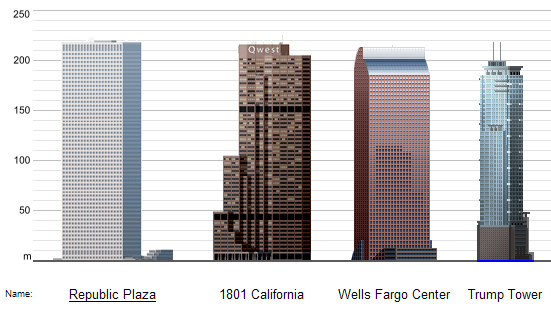
The skyscrapers of Denver

Cool site with drawings/stats on skyscrapers around the world.  Here are the top four in Denver — though Trump Tower is actually currently proposed.  My old office at 1670…

Cool site with drawings/stats on skyscrapers around the world.  Here are the top four in Denver — though Trump Tower is actually currently proposed.  My old office at 1670 Broadway is 11th on the list (7th of the built-to-date).

(via J-Walk)

No more secrets, Marty

Heck, who cares whether the NSA has been tracking our calls or Treasury has been rooting through our financial transactions. It’s all available out there already. Almost every piece of…

Heck, who cares whether the NSA has been tracking our calls or Treasury has been rooting through our financial transactions. It’s all available out there already.

Almost every piece of personal information that Americans try to keep secret — including bank account statements, e-mail messages and telephone records — is semi-public and available for sale.

[…] “We had the impression that there were no secrets any more. Now we know that for sure,” said Rep. Ed Whitfield, a Kentucky Republican and chairman of the panel’s oversight subcommittee. He described a multimillion dollar industry that sells cell phone records for $200, Social Security information for $60 and a student’s university class schedule for $80.

Most often, the customers are banks or financial institutions attempting to locate absconding debtors. But law enforcement officers — including those in the Department of Homeland Security, FBI and Austin Police Department — have used the services on occasion.

And, of course, black hats — stalkers looking for their victims, drug dealers trying to track informants, etc. — have access to the data, too, which is usually obtained under false pretenses.

The committee subpoenaed representatives from 11 companies that use the Internet and phone calls to obtain, market, and sell personal data, but they refused to talk. All invoked their constitutional right to not incriminate themselves when asked whether they sold “personal, non-public information” that had been obtained by lying or impersonating someone.

I hate to ding anyone for invoking the 5th Amendment, but it does sound like there’s something there to investigate.

The committee focused on the technique of pretexting, in which a caller contacts a phone company, utility or government agency under the pretense of being someone else, perhaps the manager of a branch office or the actual customer.

Some lawmakers shook their heads as former data broker James Rapp explained how easily and quickly he could obtain and sell a bank password or credit card record of committee members. Rapp said by offering a few pieces of personal information, such as a person’s name and address, pretexters con a customer service representative into revealing other information. After a few inquiries, they can get the Social Security number, the key to a trove of other sensitive data.

The irony here is that we’ve all grown up on TV detective shows where these techniques were used all the time by Our Hero, dialing up the DMV and getting hold of their friend there, or contacting a bank and pretending to be someone they weren’t, or going to someone they know who could get that kind of info.

But, of course, those were the good guys. Who could criticize Magnum or Face or Rockford for using their wiles to Fight Crime?

A bit different when it’s a fraud looking up your records. Or the cops doing so.

Interestingly, one of the reasons for the hearings was to delve into why a couple of bills on such data brokers have been quietly quashed by House leadership — the rumor being that it could blow back on all the government “anti-terrorist” surveillance I referenced up in the first paragraph. Well, as long as I’m being kept safe from terrorists, I guess I won’t have any cause for complaint.

Right?

(via Bruce Schneier)

The Lost Pleasure Island

In my WDW 2006 travelogue, I mentioned wondering why the Adventurers Club was the only “themed” piece of Pleasure Island. Mary (thanks!) found this article describing how PI has changed,…

In my WDW 2006 travelogue, I mentioned wondering why the Adventurers Club was the only “themed” piece of Pleasure Island. Mary (thanks!) found this article describing how PI has changed, and how the “story” behind it has been nearly lost.

Walt Disney once told Imagineer John Hench when discussing the stories behind the park attractions that, “If the guests don’t understand the story, then it is not their fault. It is our fault because we have not told the story clearly.” A story cannot be maintained and embraced if it is not frequently told. Certainly one of the challenges facing the Disney Company today is that cast members are unaware of the story about their location and how they are part of that story. For a decade or more that has been true of the Pleasure Island cast members, so they have been unable to communicate the rich history of the island to guests.

Perhaps the story for Pleasure Island was unnecessarily convoluted and complicated to begin with in order to encompass everything from a nightly celebration of New Year’s Eve to a Jessica’s of Hollywood lingerie shop to an Avigators Supply shop that featured the original Pleasure Island mascot of a flying alligator.

Recently as I walked through Pleasure Island, I saw the memorable leg-wagging sign of Jessica in a dumpster and buildings with plaques telling the story of Pleasure Island torn apart behind construction walls and a line of porta-potties dubbed by cast members as “PortAPotty Row.” Filled with sadness at what has been lost slowly over the years, I felt maybe as a final farewell, I should recount the original storyline of the Pleasure Island as it was written when the area opened in 1989 for future Disney historians.

I’ve seen some of those plaques (there’s one on the Portobello Yacht Club, among others). It’s a pity that, in trying to make PI a “hot spot” for young folk to party down or people to drive out to from Orlando and the surrounding area, they’ve jettisoned much of the storytelling that makes Disney so unique.

The tyranny of standards

As noted earlier, I just upgraded to ecto 2.0, and discovered, among other problems, a really annoying “bug”: my normal clipboard shortcut keys don’t work. So I’ve been using Windows…

As noted earlier, I just upgraded to ecto 2.0, and discovered, among other problems, a really annoying “bug”: my normal clipboard shortcut keys don’t work.

So I’ve been using Windows since 3.x, and Word for DOS before that (and, if I can digress a second, I was astonished when I visited Pasadena last week and was recognized by a secretary who I had in a Word for DOS I taught back — well, on the order of 15 years ago, at least), and the standards I learned for the clipboard were:

Shift-Del = Cut
Ctrl-Ins = Copy
Shift-Ins = Paste

Yes, I was aware that there were letter-combos for that same thing, Macintosh-like stuff on the order of

Ctrl-D = Cut
Ctrl-C = Copy
Ctrl-V = Paste

But, what the heck, I can be open-minded about such things. Never mind that I come from an era when Ctrl-C was a cancellation/interrupt command — if folks want to use it for copying to the clipboard, it’s a big tent.

Imagine my shock when, upon firing up ecto 2.0, I discovered that my shortcuts didn’t work any more, just those Ctrl-DCV things. Blasphemy! A Mac-ish Plot (not far-fetched when you realize ecto was originally a Mac product)! And, more importantly, a major change, akin to switching the side of the steering wheel the turn indicator is on (which, believe me, I’ve experienced, too).

I wrote a note to the developer in the forum, and was told that, well, no, that wasn’t how the new rich text editor worked, and that those older shortcuts were no longer standard. Which sent me digging around a bit, and I discovered, to my dismay (if not shock) that, in fact, he was right. Sort of. The Ins/Del pairings have been de jure deprecated in Windows. From MSDN’s ‘s Windows User Interface and Design Development, in the Appendix on Keyboard shortcuts, the Ctrl-Z, Ctrl-V, Ctrl-C, and Ctrl-D items are footnoted:

The system supports shortcut assignments available in earlier versions of Microsoft Windows (ALT+BACKSPACE, SHIFT+INSERT, CTRL+INSERT, SHIFT+DELETE). You should consider supporting them (though not documenting them) to support the transition of users.

And I found that through another reference that the deprecation dated back to Win95 and WinNT. Yikes.

But it’s worth noting that despite the old deprecation, I’m not aware of a single current M$ application that doesn’t still “support the transition” with them. It may not be the de jure standard, but it is the de facto standard.

It is doubtless a waste of keyboard combos to support two different ways of manipulating the clipboard, but it seems to me the last thing you want to do is break something that people do automatically unless there’s a significant reason to do so. And adherence to a standard is not a significant reason; it’s a method. The reason would have to be some other use for those keys, or some technical problem. Otherwise, it would be just as simple to change the standard to Alt-A, Alt-B, Alt-C, and Alt-D. I mean, just because there would be confusion for no purpose doesn’t mean it’s wrong, so long as it adheres to the current standard, correct?

For what it’s worth, the ecto developer has put adding in the other shortcuts onto his to-do list, which is nice of him. But that may happen sometime in the distant future and, to be perfectly honest, it’s a real turn-off from retaining the upgrade (especially with some of its other problems) until it gets fixed.

Your software development lesson for today: Don’t mess with how people do things with your product, unless you can offer them real value for doing so.
Sudoku vs. Cross-words

Interesting New York Magazine article on the modern evolution of cross-word puzzles — and the challenge they face, popularity-wise, from newcomer numeric Sudoku puzzles. I’m not a heavy-duty cross-worder –…

Interesting New York Magazine article on the modern evolution of cross-word puzzles — and the challenge they face, popularity-wise, from newcomer numeric Sudoku puzzles.

I’m not a heavy-duty cross-worder — maybe one or two a month, usually in a flight magazine or something — but I enjoy them. I’ve tried Sudoku, and it just doesn’t do it for me (though I used to be quite the number puzzle kind of guy). It is interesting, though, the shift in popularity. Is it a matter of novelty, a change in thinking patterns (numeric vs lexical), or what?

What precisely is the allure? Shortz argues that Sudoku has a secret psychological hook. While solving them, you tend to get bogged down midway—then suddenly break through, fill in the last bunch of empty boxes in a row, bang bang bang. “It gives you a satisfying feeling to be rushing at those squares,” Shortz says. “And immediately you want to do another one. That’s the key to why they are so addictive.”

Yet it is also, in a way, a total negation of crossword culture. Sudoku requires no knowledge of trivia or history, no literary bent. Sudoku doesn’t care what you know, smarty-pants; it just wants you to act like a logic cruncher, a Pentium chip. “It’s not what you know—it’s how you think. That’s what Sudoku tests,” says Gould. Its nonlinguistic nature is precisely why it has spanned the globe so quickly: A puzzle created in the U.S. can be sold to China or Germany with no translation necessary, and American immigrants who don’t speak good English can happily solve Sudokus.

Less charitably, one could regard Sudoku as the lowest common denominator— a puzzle for a nation whose citizens no longer presume to have any culture in common. “I don’t want to call it a dumbing down of society,” Abby Taylor, Dell’s editor-in-chief, says delicately, but she has noticed that nonlanguage puzzles like Sudoku—or nondemanding ones like word searches—have been steadily increasing in sales, while sales of difficult crosswords remain flat.

So as you’d imagine, many crossword fanatics regard Sudoku with the disdain a jazz purist might have for American Idol. “It interests me about one-tenth as much as the crossword,” Rosenthal says with a shrug. For crossword constructors, Sudoku represents a robotic outsourcing of the puzzle trade. Sudoku requires no individual artistry, no exquisite handcrafting; the puzzles are simply cranked out by computers, the Coca-Cola of conundrums.

It would be interesting to look ahead five or ten years and see what’s going on then.

(via GeekPress)

Real Life Merit Badges

Or Photoshopped suggestions thereof. Hi-larious….

Or Photoshopped suggestions thereof. Hi-larious.

The limits of unity, Part II

Evidently, the idea of a several-year process of developing an Anglican Communion covenant and membership structure, though applauded yesterday by Anglican conservatives inside and outside of the Episcopal Church, is far too…

Evidently, the idea of a several-year process of developing an Anglican Communion covenant and membership structure, though applauded yesterday by Anglican conservatives inside and outside of the Episcopal Church, is far too slow a process for those same conservatives.  Thus, also yesterday …

  1. The Church of Nigeria has elected a US “bishop” for a “missionary” initiative within the US and Canada (under CANA, previously known as the Convocation of Anglican Nigerians in America, but now called Convocation of Anglican Churches in North America).
  2. Several conservative dioceses (or their bishops) have appealed to the Archbishop of Canterbury for “Alternative Primatial Oversight” (amusingly called “ALPO”), i.e., to be overseen by a primate other than the Episcopal Presiding Bishop.  Not that the PB actually has any control over the dioceses, but it’s the thought that counts.

This gets a lot more into church politics than most folks are likely interested in, but, frankly — fine.  My thought is, let’s acknowledge the schism and severed relationships and move on with, well, doing what Jesus had in mind (I don’t recall him, frankly, talking a lot about ecclesiastical organization, except for some not-very-complementary comments about whited sepulchres and the like).

So, anyone who want to leave — do so.  But do so openly and honestly, and leave your keys by the door (or be ready to argue out in court who owns what).  Playing games like this is unbecoming and, frankly, un-Christian.

For more reading on the subject (rather than try and backfit the links), I recommend the Daily Episcopalian, Fr. Jake, Preludium, the Episcopal
News Service
, and a whole bunch of news links.

Note to self

Next time someone in my group is going to be let go, thus needing (per their state law) their final paycheck (including two weeks severance) delivered to them upon termination,…

Next time someone in my group is going to be let go, thus needing (per their state law) their final paycheck (including two weeks severance) delivered to them upon termination, remember to confirm with HR that they will tell Payroll to cut a manual check for the calculated amount, as opposed to having someone go in and fill out electronic timesheets for the person for the rest of the week and the two following. The latter is programmatically more simple, but it does have the unfortunate consequence of sending the individual in question e-mail noting that their next three timesheets have been filled out, which in turn may raise questions prematurely …

Political Rhetoric

So I get e-mail from the Democratic Congressional Campaign Committee, and it’s — extraordinarily aggravating. I mean, I really want to root for the Dems as they muster up support…

So I get e-mail from the Democratic Congressional Campaign Committee, and it’s — extraordinarily aggravating. I mean, I really want to root for the Dems as they muster up support against various GOP candidates and try to break the Republican one-party stranglehold on Congress. A worthy cause that I’d support even if I were a (real) Republican.

But, damn, people, the irony gets slathered on thick as, on the one hand, you quote Karl Rove saying something outrageously partisan, and then engage in the same rhetorical cheap shots and innuendo that have marked Republican scare tactics and talking points since at least the Newt Gingrich era. And if folks like DeLay and Frist and their ilk make my blood boil, listening to people like Pelosi talk (or write) is like the proverbial fingernails-on-the-blackboard.

*sigh*

Failure is an option

Doyce linked to this a few days back, from the HeroQuest site: Failure is Always An Option: Character Defeat is Player Victory, Too. One of the cool things about HQ…

Doyce linked to this a few days back, from the HeroQuest site: Failure is Always An Option: Character Defeat is Player Victory, Too. One of the cool things about HQ and other story-telling type of systems — vs, say, D&D — is that what “failure” means is flexible enough to actually be something interesting for the players. It’s not (or shouldn’t be) all binary “You kill the orcs” or “The orcs kill you.” Indeed, it ties in with the management catch-phrase of calling problems “opportunities.”

Cool stuff. A good read for any GM.

How Micro$oft will encourage upgrades to Windows Vista

By slowly but surely decertifying all valid Windows XP licenses, through its new Windows Genuine Advantage (WGA)program.  This system is now required if you want to download any security…

By slowly but surely decertifying all valid Windows XP licenses, through its new Windows Genuine Advantage (WGA)program.  This system is now required if you want to download any security and system updates.  And what it does is keep track of your PC and continues to “certify” it’s the system you bought the operating system for. 

Oh, and it phones home every 24 hours.  But never mind that — “we just forgot to tell you about that part.”  And it’s still a test system, but it’s being forced on users.  But never mind that — “quality is our highest priority.”

Problem is (aside from all that), as PCs get upgraded or their hardware is changed — or sometimes just for strange random reasons — WGA begins to think that it’s not the original system.  At which point you get cut off from upgrades, klaxons hoot in Redmond, and M$ Tech Support assumes you’re a fiendish pirate out to pollute their precious bodily fluids.

Things get more wrong once WGA registers a false positive when checking for counterfeit copies of Windows. “I bought my PC about three years ago and it had a product key on top to verify that the XP operating system was good,” another reader wrote. “I have upgraded over the years with the latest Microsoft fixes. I have done verification several times and tried to follow the rules. I was verified last year when I loaded Microsoft Antispyware program. Last week I received a pop-up to indicate that a new release
of Antispyware was available. I replied yes to upload the program, then it indicated that it would validate my system. I replied yes to that message. After that, my system now gets the message that I may be a victim of software counterfeiting. If I want to stop these pop-ups and remove the message, send them $149.00 and they will give me a valid operating system. I looked on their list of invalid systems and I cannot find my number. I sent them a message and the indications are they will not help. If I do not
like it, sue. What can a person do? Suing costs more than $149.00.”

Just because a customer’s version of XP has been validated as genuine in the past doesn’t mean it won’t be invalid the next time. “How is it that my same version of Windows that Microsoft said was ‘genuine’ last year is now not genuine?” another reader wondered. “I bought this machine directly from HP, and the HP service center is the only ones who have touched it other than me. Microsoft says the HP techs must have re-installed Windows incorrectly — HP says no way. The only thing everyone agrees on is that
it’s my problem. This is just a ‘genuine’ rip-off!”

M$, of course, says it’s all a great service on their part, to make sure that companies and consumers haven’t inadvertently had counterfeit software foisted on them.  How noble of them.

Micro$oft has a legitimate business interest in protecting its sales from pirates.  But it’s leveraging its near-monopoly of desktop computing to push ill-structured, invasive, and costly solutions on its customers.  Isn’t that special?

Paging Doctor Zaius …

Spain is breaking new ground in animal rights — by blurring the animal/human line and asking for human rights treatment for Great Ape. Spain’s parliament is to declare support for…

Spain is breaking new ground in animal rights — by blurring the animal/human line and asking for human rights treatment for Great Ape.

Spain’s parliament is to declare support for rights to life and freedom for great apes on Wednesday, apparently the first time any national legislature will have recognized such rights for non-humans.

Parliament is to ask the government to adhere to the Great Ape Project, which would mean recognizing that our closest genetic relatives should be part of a “community of equals” with humans, supporters of the resolution said.

Raises a lot of interesting question, but it’s also kind of cool. More info at Collision Detection.

Is a flag-burning amendment the most important thing the Senate could be doing right now?

Quoth Orrin Hatch (R-UT): “You’re darned right it is.” Well, that settles that! I’m surprised they’re not hammering at it 24x7x365 until it’s fixed! Does make me wonder about those…

Quoth Orrin Hatch (R-UT): “You’re darned right it is.

Well, that settles that! I’m surprised they’re not hammering at it 24x7x365 until it’s fixed!

Does make me wonder about those slackers who took time out to debate video game violence

(via J-Walk)

Do you have what it takes to be a citizen?

MSNBC provides twenty sample questions: When immigrants want to become Americans, they must take a civics test as part of their naturalization interview before a Citizenship and Immigration Services officer….

MSNBC provides twenty sample questions:

When immigrants want to become Americans, they must take a civics test as part of their naturalization interview before a Citizenship and Immigration Services officer. The questions are usually selected from a list of 100 sample questions (see at http://www.uscis.gov/graphics/services/natz/English.pdf ) that prospective citizens can look at ahead of the interview (though the examiner is not limited to those questions). Some are easy, some are not. We have picked some of the more difficult ones. Should you be welcomed immediately to the Land of the Free or sent home for some more homework? Find out!

(PLEASE NOTE: These questions are as asked on the official United States Immigration and Naturalization Services Web site. Candidates are not given multiple choices in the naturalization interview, which is conducted orally.)

I got 95%, though I was glad it was multiple choice in a few cases, and a couple were outright guesses.

(via ISIP)