
… being-sick difficulties. Better soon.
… being-sick difficulties. Better soon….
… being-sick difficulties. Better soon.
Who was Joan of Arc? (Wikipedia) Huzzah for the Five Second Rule. And it may be even longer than that. Fleet mileage standards are bad, and nasty, and uncompetitive,…
Though Reilly’s lengthy resume had both a stage career (with Tony Award) and numerous appearances on The Tonight Show, my own recollections of him were as the nervous-nelly avaricious real…
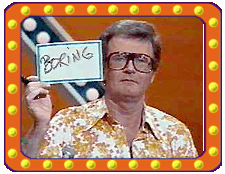
Though Reilly‘s lengthy resume had both a stage career (with Tony Award) and numerous appearances on The Tonight Show, my own recollections of him were as the nervous-nelly avaricious real estate owner Claymore Gregg on the TV version of The Ghost and Mrs. Muir, the main bad guy Hoodoo on the Sid & Marty Krofft Lidsville (“How’s that for a topper?”), and the flamboyantly gay (though never identified as such) and clever perennial panelist (himself) on Match Game. He entertained at each role.
The ballots are in and the brave Anglican faithful of Grace & St Stephens in Colorado Springs have voted to sever ties with the nassssty Episcopal “church” and follow the…

The ballots are in and the brave Anglican faithful of Grace & St Stephens in Colorado Springs have voted to sever ties with the nassssty Episcopal “church” and follow the voice of their conscience and the Holy Spirit into aligning with CANA and the Church of Nigeria.
More or less. Mostly less.
A majority of voting members at Grace Church and St. Stephens Parish in Colorado Springs have declared their willingness to break away from the Episcopal Church to join a conservative Anglican network more in line with their beliefs, according to spokesman Alan Crippen.
The vote, tallied Saturday, showed 93 percent of 370 voting members approved of the plan to leave the Episcopal Church, Crippen said. It capped an ongoing period of uncertainty that began March 26 when parish rector, The Rev. Don Armstrong, and a majority of the church’s governing board, declared they were each individually leaving the Episcopal Church and the Diocese of Colorado.
So says the article by Jean Torkelson, who adds, generously,
Because the schismatic act was so unusual, the breakaway parish leaders said they would set up a vote to determine what parishioners wanted to do.
What is missing from the story is both how the (remaining, presumably dissenting) parishioners went through a 40 Days of Indoctrination Discernment from CANA, describing how the Episcopal “church” was heretical and dying and Not Very Nice. Also missing was what those numbers represent.
According to a report in the Colorado Springs Gazette, there were 370 votes cast and 342, or 93%, were in favor of the parish leaving the Episcopal Church and joining CANA. The tally was 348 to 22 about authorizing the vestry to fight to retain control of the $17 million dollar plant.
Wow! A huge majority. But a huge majority of what?
Before the break-up, the parish reported a membership of 1500-2000 communicants. The breakaway parish claims 600 to 800 of these, while the Diocese claims that 200 to 400 members of the original parish now worship in the borrowed space down the street.
So of the original reported membership (which reporting by the pastor and vestry is regulated by canon law and is the basis for voting representation in the diocesan convention), taking 1,500 as a lower bound, 22.8% voted to secede. Even if we take the vestry’s claim of lower bound of 600 dissenters (which represents less than half of the previously reported communicants), that’s still a bare 58%.
The vote was supposedly open to all members in good standing. The folks who continued to align to the diocese had previously (and, to my mind, mistakenly) declared they would not participate in the vote. And that question of who could actually vote was not insignificant.
The leadership of the Episcopal parish contends that the rules established by the breakaway parish make the outcome of the vote a foregone conclusion. The rules establised for the vote require that members of the Episcopal parish must re-register as members of the CANA congregation, contribute to the new congregation and attend its worship. Members of the Episcopal congregation voiced concern that the use of the rolls, or even the possibility of signed ballots, might be used in court in validate the breakaway parish’s claim.
Information posted by the CANA parish about the vote published in their newsletter and posted on their website was unclear as to the eligibility of Episcopalians who might have attempted to vote, except to say that some cases would be handled individually. The question of a necessary quorum is also not addressed in the newsletter.
Despite that, the pro-CANA/Armstrong forces declared it a major victory.
[Parish spokesman Alan] Crippen said he believed the “no” votes on both ballot questions came from Grace Church members loyal to the diocese and to Bishop Rob O’Neill, even though the Episcopal loyalists had said all along that they would refuse to legitimize Armstrong’s cause by participating in the vote.
Crippen said the will of the voting majority was indisputable, “and showed clearly a very strong mandate to affirm the vestry decision of March 26 (to leave the Episcopal Church).”
The diocese, on the other hand, considers the vote illegitimate, as parishes are formed by the diocesan convention and the bishop, as petitioned by members of the parish, and those parishes cannot simply choose to walk off with their name and property intact.
As the diocesan loyalists continue to meet under another roof, civil proceedings regarding the parish property proceed, and ecclesiastical proceedings against Rev. Armstrong for financial malfeasance (separate from the whole “I’m a member of CANA, not the Episcopal Church” charges that could be levied) continue.
In addition to all the car hunting, we also went to the Denver Botanic Gardens, which was simply spectacular (everything was in bloom except for many of the roses; took…
In addition to all the car hunting, we also went to the Denver Botanic Gardens, which was simply spectacular (everything was in bloom except for many of the roses; took tons of beeyooteeful pictures), and then had dinner at Le Central. Good times.
We took advantage of my folks being in town to go look at cars — in particular the two somewhat-oranges-to-apples cars we’re considering, the Toyota Sienna with AWD, and the…
We took advantage of my folks being in town to go look at cars — in particular the two somewhat-oranges-to-apples cars we’re considering, the Toyota Sienna with AWD, and the Subaru B9 Tribeca. Bear in mind our prerequisites for the new vehicle. We test-drove a Tribeca Limited and a Sienna LE.
Minivan vs. Medium-sized SUV … fight!
Ride: Both cars have various stabilization and traction and compensation widgets out the wazoo (including, of course AWD — a variation on the Toyota, an intrinsic on all Subarus). Both were, overall, fine. The Toyota felt a bit zipper from zero, and rode more smoothly; the Tribeca feels the road better, and I had a vague sense maneuvered a bit better. Local rides would probably have a sportier feel in the Tribeca; a drive to California (or around the block) would probably be a bit more comfy in the Sienna. Advantage: Sienna (a scosh)
Fuel economy: Remarkably — annoyingly — it’s a wash. The Tribeca and (AWD) Sienna are both 18 mpg street, 23 mpg highway.
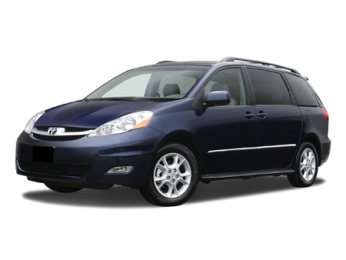
I’d like something more — but the other features we want (reliability, AWD, seating/space) make it hard to get something — yet — that will get much better. I have to acknowledge our “carbon footprint” and fuel expenditure, as well as the added budgetary cost to us to weigh against the other things we want. I like to think we have a bit more justification than wanting a Big Yuppiemobile, but it’s still something I have to acknowledge. Advantage: Tie
Widgets: Both cars had rear DVD players with wireless headphones and lots of jacks. Both had back-up sonar that gave a warning if backing into something. Both had jacks for an MP3 player and six-CD changers.
The Sienna had front seat warmers. It had both AC power jacks (a/k/a cigarette lighter outlets) and at least one DC “normal” outlet, which is nice. It had more cup holders front and back. The dashboard is less purty, but more functional and usable than the Tribeca. Nicer color combos interior/exterior.
The Tribeca had a front navigation panel screen (which, at a stop, could show the DVD being played), with both a map navigation package, various computer readouts and all that. The screen also served as a rear-view for parking — very nice (and very necessary, given the limited sight lines). It had independent climate control in the front. It had “puddle lights” (downlights at each door to see what you’re stepping into at night). The MP3 player jack (and two of the power outlets) are in the between-seat console, which makes it convenient for charging cell phones and MP3 players, too. It has fog lamps standard (the Sienna has it standard on the XLE).

The Sienna is less feature-rich and whizzy — at the LE level, at least — than the Tribeca. Question is, are those differences really valuable differences? Advangage: Tribeca (a bit)
Size – Exterior: Our old Sienna is 193.50” long, 73.40” wide. The new one is 201″ long (an extra 7.5″!) and 77.4″ wide (an extra 4″). That doesn’t sound like much — but it’s very tight quarters in our garage (in both dimensions), and that makes it all the tighter.
In comparison, the Tribeca is 190″ long (3.5″ less), 73.9″ wide (0.5 inches wider) — a small improvement in length, and an insignificant difference in width, though note that with opening doors rather than sliding doors, that makes getting in/out a scosh more difficult. Advantage: Tribeca.
Size – Interior: A mixed gig here. The Sienna second row is Captain’s Seats (one of which can be slid left to make it all into kinda-bench seat); the spacing is comfortable. The third row is a 40-60 split bench. The third row is cozy, but not cramped.
The Tribeca has a bench second row that can be dropped down 40-20-40. When the third row is open, the second row seats are restricted in how far they can go back, making them a bit cramped (not helped by a hard bar at ankle height: with the third row closed, the second row has plenty of leg space. The third row is very much an expediency for either kids or for “we have to fit an extra adult in somehow.” I wouldn’t want to travel more than 20-30 minutes in it.
The question for us, of course, is how much we’d use that third row. In the Sienna, more, because the second row only accomodates two; if we have five passengers (we three plus two grandparents, for example), that requires spill-over to the back-back. If we were in the Tribeca, though, three can sit comfortably in the third row (if Katherine’s one of the three, and she remains 7 years old), reducing the need for third row use.
Headroom-wise, the Tribeca is two inches shorter in the front seat than the Sienna, but I could wear my hat in both of them. I could do so in the second row, too, though it brushed the ceiling in the Tribeca.
In the third row, the same differential maintains, but headroom is down to 36″ in the Tribeca, 38 in the Sienna.
(Interestingly, the Sienna moon roof takes up an inch more than the Tribeca’s.)
The general interior space — shoulder room and such — is a distinct advantage for the Sienna, at the cost of the exterior space.
Cargo-wise, the Sienna’s cubic feet behind front, second, and third rows are 150, 95, and 44 cubic feet; the Tribeca is 74.4/37.6/8.3 cubic feet. Serious advantage for the Sienna here — but I need to do some follow-up measurements. How wide is the read hatch? How deep is the Sienna with the third row down and the second row tumbled forward vs the Tribeca with the third and second rows down?
Regardless, the Sienna definitely has more room. The question will be is the extra something that we need? Advantage: Sienna (somewhat)
Company imponderables: We’re big fans of both Subaru and Toyota, from past experience. I trust Toyota to do things right — but I trust Subaru more with AWD technology (in particular, with being AWD from the ground up, rather than modifying the Sienna design to have an AWD version). Advantage: Tie
Price: Pretty close. The particular package and options features make it tough to know until you get to the final vehicle as-is. That said, the Tribeca Limited (the upper of the two packages) MSRP starts at $32.5K; the Sienna XLE (the second-toitiest of four versions) AWD starts at $33.3K; the LE (third-tier) AWD is $29.3K. So one way or the other, depending on what car we decide on, it’ll be a big chunk of money. Advantage: Tie
Bottom line, either car would suit us fine. Both would have advantages and strengths. Both would have weaknesses and things we’d be mildly irked by — but neither car is likely to give us much grief and both cars are likely to be a lot of fun.
So it’s mostly (unless we’ve missed something) a matter of minor differences that need to be weighted to the point where the question is settled.
As an aside, rather than Burt dealerships, who we visited on our last outing, we went to the Go (formerly John Elway) dealers on Arapahoe. Much nicer operations. Our Toyota guy was an young Russian, our Subaru guy was an old American, but they were both pleasant, professional, non-pushy. I hate to recommend car dealers, but I didn’t feel either predated or slimed upon when we left, which is saying something in the car sales biz.
Overall Food Service Ambience Prices Casa Bonita is something of a Denver landmark, (in)famous since 1974 for cheesy entertainment and mediocre Mexican food. That reputation is deserved. Katherine had been to…
| Overall |  | ||
| Food |  | Service | |
| Ambience |  | Prices | |
Casa Bonita is something of a Denver landmark, (in)famous since 1974 for cheesy entertainment and mediocre Mexican food.
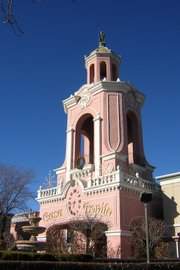
That reputation is deserved.
Katherine had been to CB before, on some sort of field trip. She was so enthusiastic about it, and so desirous of our going there some time, that we figured it would be a great location for her birthday. And, despite some … serious flaws in the dining experience, it was, in fact, a great location for her birthday.
Food: Let’s get the down side of this out of the way first. CB has a limited menu; folks are encouraged to go for the “Deluxe” dinner — all you can eat from either a chicken plate (enchiladas and tacos) or beef plate. Once you run out, you raise a little flag at table-side and someone scurries up to refill your plate.
That’s the assumption, at least. We never tested it. Four adults, four deluxe plates, no requests for anything further. To call the food bland is to imply too much flavor to it. The “cheese” tasted and felt like it came from a jar and a microwave (though it was plentiful). The “hard” taco shells were steamed soft. The food was … wait, I already used the word “bland.” And we were busy dribbling salsa for our chips onto it to give it any sort of flavor. (The salsa did have a bit of a kick.)
The sopapillas weren’t bad — but sopapillas aren’t all that tough to do, either.
I had a margarita. It was … about as interesting and authentic as the cheese. I should have gone for the bottled beer.
Service: Folks were polite, but brisk. Entry into the place was in long, snaking lines — I was riffing on a Disney ride — with someone along the way taking orders, then someone else keying them into a computer, then picking the food up from another station, then picking the drinks up from another station, then being walked in to a seating station, then being escorted somewhere to be seated.
One of the things we ordered was never delivered, though it showed up on the bill.
Ambience: Ah. Here’s where Casa Bonita shines. Constant entertainment, especially for the kids. Cliff diving routines (yes, there are cliffs, and a diving pool), comedy routines of various sorts, pinata thwacking, video/ticket arcades, mini-haunted houses, puppet shows, mariachi players … There’s a ton of stuff to see and to do.
We were seated (at random) at a fabulous table with great sight lines to the stage, the diving area, the mariachis.
Katherine had an exhausting blast. Margie and my folks showed the patiences of saints in hanging out while Katherine and I toured the place for an hour or more. And Katherine is insistent that Margie should come back for her birthday in October, so that we can see the place dressed up for Halloween.
Price: The food was pretty inexpensive ($11 for the “Deluxe” dinner). The quality and potential quantity makes that a reasonable bargain — especially with the entertainment provided.
Overall: Casa Bonita is difficult to quantify. Katherine thinks it’s the most faboo place in the world. I would rather pitch a tent in Chuck E. Cheese than return there. I have to say, though, that judging by their real target demographic, it deserves its rep both as entertaining (especially for a 7-year-old) and as a mediocre dining experience (especially for adults or for anyone looking for something that resembles Mexican food more than a Swanson’s Enchilada TV Dinner does). It’s equally deserving of being a Denver landmark (and the subject of a South Park episode).
If I never go back again, I won’t regret it. But I am kinda glad I went at least once.
Happy Birthday, Kitten.
‘Rents in town, Kitten having a birthday, running around like crazy people. Blogging to continue anon….
‘Rents in town, Kitten having a birthday, running around like crazy people. Blogging to continue anon.
For the longest time, I struggled to remember which holiday came at the beginning, or at the end, of the summer. Finally figured out that it goes in reverse-alpha…

For the longest time, I struggled to remember which holiday came at the beginning, or at the end, of the summer. Finally figured out that it goes in reverse-alpha order (Memorial, then Labor Day).
Anyway — dear Lord, an insane day. Walking in the door (metaphorically), my schedule was already booked 90% with phone conferences — some of which are Big, Major, Dire Meetings of Great Consequence (personnel issues, troubled projects, SOx meetings, CIO meetings). I also had a status report and a big quality matrix I need to do (a normal weekly assignment, usually done on Fridays). Plus I have my scheduled “sift through and archive off some of the several thousand e-mails of the last three months so that they don’t get disappeared into the bit bucket” task. Plus, somewhere in here, my folks are arriving at the house — and I’m at home taking care of Margie who’s sick.
And, on top of that, three of my direct reports have asked if they can grab a chunk of my time on the phone today for Important Stuff.
*sigh*
I’m so ready for a long weekend …
Who was St Ivo? Should you buy the new “forever” stamps? Nope. Stamp prices rise slower than inflation. In fact, by law, they now cannot rise faster than inflation…
Posters at Orlando Airport for Star Wars Days at Disney-MGM. Excellent….
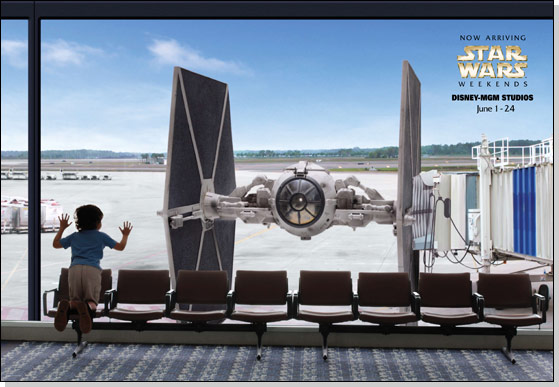
Posters at Orlando Airport for Star Wars Days at Disney-MGM. Excellent.
Weird story here. A Liberty University student was arrested at Jerry Falwell’s funeral with some home-made incendiary bombs. But nobody seems to think it was to disrupt the funeral, but that…
Weird story here. A Liberty University student was arrested at Jerry Falwell’s funeral with some home-made incendiary bombs. But nobody seems to think it was to disrupt the funeral, but that the student was upset with some of the Fred Phelps/Westboro Church crowd who were protesting at the funeral (who, demonstrating their general loopiness, accuse Falwell of being a “friend” of gays).
The devices were found in the student’s car trunk. Police were tipped off by a family member, and are also searching for friends of the student who may have helped in building the incendiaries.
The student was an Army ROTC member, and was studying to be an Army Chaplain.
Lots more details to come, no doubt.
(via BD)
… like spending 90 minutes, first thing in the morning, wading through a technical feud between ostensible professionals who happen to work for me (and who are normally bright, competent, effective…
… like spending 90 minutes, first thing in the morning, wading through a technical feud between ostensible professionals who happen to work for me (and who are normally bright, competent, effective people). So not needing this …
As every politician, advertising executive, and blogosphere denizen knows. Repetition of an opinion adds to its persuasiveness, as well as the perception that the opinion is widely held. The “echo…
As every politician, advertising executive, and blogosphere denizen knows. Repetition of an opinion adds to its persuasiveness, as well as the perception that the opinion is widely held. The “echo chamber” does have an impact, squeaky wheels are seen as needing grease, and small, organized phone and letter campaigns can have an effect far beyond their real numbers.
Whether people are making financial decisions in the stock market or worrying about terrorism, they are likely to be influenced by what others think. And, according to a new study in this month’s Journal of Personality and Social Psychology, published by the American Psychological Association (APA), repeated exposure to one person’s viewpoint can have almost as much influence as exposure to shared opinions from multiple people. This finding shows that hearing an opinion multiple times increases the recipient’s sense of familiarity and in some cases gives a listener a false sense that an opinion is more widespread then it actually is.
[…] The studies found that an opinion is more likely to be assumed to be the majority opinion when multiple group members express their opinion. However, the study also showed that hearing one person express the same opinion multiple times had nearly the same effect on listener’s perception of the opinion being popular as hearing multiple people state his/her opinion.
(via kottke)
For the meeting of Anglican bishops at Lambeth next year, the Archbishop of Canterbury (the “ABC,” as we Anglicans call him) has sent out his invitations … but for…
For the meeting of Anglican bishops at Lambeth next year, the Archbishop of Canterbury (the “ABC,” as we Anglicans call him) has sent out his invitations … but for all the 800-odd bishops invited, he’s explicitly left two out.
One is Gene Robinson, the Bishop of New Hampshire, an openly gay man whose election as bishop by the diocese, and acceptance of same by the General Convention in 2003, has been the flash point for much of the Episcopal brouhaha since.
The other is Martyn Minns, who was officially invested as a bishop in the Church of Nigeria (but serving in the United States) by Abp Peter Akinola earlier this month, a cross-territorial move that was flew in the face of requests by both the Episcopal Church and of the ABC.
It’s a move that raises a lot of questions. First off is the social rudeness and ecclesiastical disunity involved in not inviting somene. But it also raises questions of whether the two were chose as opposite ends of the current Anglican split. Or, alternately, if the ABC really felt that one or the other would disrupt things too much (less as an individual and more for what he represented) but didn’t want to single out any one “side.”
For example, I suspect that had Bp Robinson been invited, some other bishops would have either refused to attend, or would have felt compelled to make some other overt sign of their displeasure. Ditto (though to a lesser degree) for Bp Minns.
(In further reading of other sources, it appear that the ABC left out Bp Robinson because of the controversy around him, even while acknowledging him as a real bishop. Bp Minns was also acknowledged a bishop, but CANA, his missionary group from Nigeria, is not identified as a consituent member of the Anglican Communion, a judgment that will doubtless stick in a few craws.)
“I have to reserve the right to withhold or withdraw invitations from bishops whose appointment, actions or manner of life have caused exceptionally serious division or scandal within the Communion,” Williams wrote in his invitations, which were sent out on Tuesday.
“I do not say this lightly, but I believe that we need to know as we meet that each participant recognizes and honors the task set before us and that there is an adequate level of mutual trust between us about this.”
The problem being, of course, that to withhold invitations is, itself, a sign of disunity and division. And, of course, “causing exceptionally serious division or scandal” is more than a little bit subjective. Someone would claim that of Abp Akinola. Some would claim that of Bp Jefferts Schori, the Presiding Bishop of the Episcopal Church. I can certainly think of multiple bishops in the Episcopal Church who have acted in a scandalous, divisive fashion.
But, the, maybe the ABC is also thinking of some or all of the above.
It is possible that others will either not be invited or will have their invitations withdrawn before the conference takes place if anything “untoward or unacceptable” occurs between now and then, an Anglican spokesman said.
“There are one or two other cases where the archbishop is currently seeking further advice,” Tim Livesey, the head of public affairs for Lambeth Palace, told reporters.
Frankly, I think it’s a mistake on the ABC’s part. If someone chooses not to attend because of who else is there, that is their choice. Ancitipaing their criticism and proactively moving to avoid it is an attempt to avoid the truth, to paternalistically sacrifice the feelings of some of the feelings of others. Leaving out canonically invested bishops because division has erupted around them is not only a slippery slope, but flies in the face of the unity that the ABC claims to want to hold onto.
Of course, up to now, the ABC has been more accused of indecisiveness in the face of all the contention, and, alas, even in this (counterproductive) firm stand, he’s also betrayed his lack of commitment to his actions.
While the non-invitation of Robinson and Minns is likely to provoke debate, particularly in the United States and Africa, Livesey said it was possible that Robinson, at least, could be allowed to come as a “guest” of the conference — a minor concession that might temper criticism. “The archbishop is currently studying that possibility,” Livesey said.
A solution likely to appeal to none of the parties involved.
More from Father Jake (who notes others not invited), the Admiral of Morality, .
(via BD)
On the other hand, though most of the media is focusing on Bp Robinson not being invited, the exclusion of Bp Minns, too, may be all worthwhile to have pulled this response from Nigeria and Abp Akinola:
Since only the first set of invitations had been sent, it is premature to conclude who will be present or absent at the conference. However, the withholding of invitation to a Nigerian bishop, elected and consecrated by other Nigerian bishops will be viewed as withholding invitation to the entire House of Bishops of the Church of Nigeria.
Would that the Episcopal House of Bishops treat the snubbing of Bp Robinson the same way. Though this may mean that the Church of Nigeria and other Global South provinces may just stay away from Lambeth. Which might be a very good (if sad) thing.
The BBC News reports Canon Dr Chris Sugden “The quarrel is not with Gene Robinson but with the 60 bishops who consecrated him and indeed the leadership of the Episcopal Church. If the Archbishop was going to be just clear and transparent and honest he would not invite Gene Robinson or the 60 people who consecrated him.”
So much for the ABC trying to avoid controversy and division.
The ABC has asked for RSVPs by the end of July. Interestingly, the Episcopal Church has until the end of September to respond to the “demands” of the Primates meeting this past spring — the result of which response might lead to some further shuffling of invitations and acceptances.
*sigh* Interesting times.
So Sensei handed out belts won at the testing last Thursday, and both Mary and I got our yellow belts. Woot! Of course, that means that we’ve gone from…
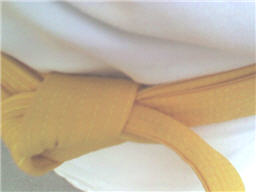
So Sensei handed out belts won at the testing last Thursday, and both Mary and I got our yellow belts. Woot!
Of course, that means that we’ve gone from being utter greenhorns (to mix my color metaphors) to being folks who should know something of what we’re doing. Which, in turn, also means that we now get to learn something new (i.e,, so that we still don’t know what we’re doing).
The next kata we learn, then, is Heian nidan (while still, of course, keeping up with our basics and our sparring and our previous kata). For those who want to see how it should look, YouTube has numerous videos; the one below does a decent job (at full speed, then slower), as does this one. If you want to know how I look doing it … imagine Inspector Clouseau practicing his moves with Kato …
And in case you’re wondering what all the point of these fancy moves is, this video goes through the kata with with at least one interpretation of actual “opponents.”
Anyway, it’s very cool being a yellow belt (it makes for nicer contrast to the white gi) — but we’re still (at the moment) the lowest ranked individuals in the class, so no delusions of karate grandeur here. 🙂
As thousands gathered to mourn Rev. Jerry Falwell at his funeral today, I’ll point to this article that looks back at Falwell’s earliest activism, and some of the founding impetus…
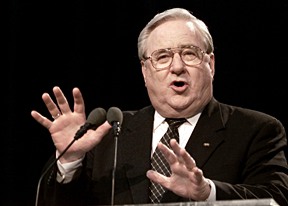
As thousands gathered to mourn Rev. Jerry Falwell at his funeral today, I’ll point to this article that looks back at Falwell’s earliest activism, and some of the founding impetus behind the Moral Majority. Abortion and school prayer and homosexuality had little to do with it.
Decades before the forces that now make up the Christian right declared their culture war, Falwell was a rabid segregationist who railed against the civil rights movement from the pulpit of the abandoned backwater bottling plant he converted into Thomas Road Baptist Church. This opening episode of Falwell’s life, studiously overlooked by his friends, naïvely unacknowledged by many of his chroniclers, and puzzlingly and glaringly omitted in the obituaries of the Washington Post and New York Times, is essential to understanding his historical significance in galvanizing the Christian right. Indeed, it was race–not abortion or the attendant suite of so-called “values” issues–that propelled Falwell and his evangelical allies into political activism.
As with his positions on abortion and homosexuality, the basso profondo preacher’s own words on race stand as vivid documents of his legacy. Falwell launched on the warpath against civil rights four years after the Supreme Court’s Brown v. Board of Education decision to desegregate public schools with a sermon titled “Segregation or Integration: Which?”
“If Chief Justice Warren and his associates had known God’s word and had desired to do the Lord’s will, I am quite confident that the 1954 decision would never have been made,” Falwell boomed from above his congregation in Lynchburg. “The facilities should be separate. When God has drawn a line of distinction, we should not attempt to cross that line.”
Falwell’s jeremiad continued: “The true Negro does not want integration…. He realizes his potential is far better among his own race.” Falwell went on to announce that integration “will destroy our race eventually. In one northern city,” he warned, “a pastor friend of mine tells me that a couple of opposite race live next door to his church as man and wife.”
Falwell didn’t start rallying the troops until (according to the author) governmental forces started to take aim at the racially segregated private schools that Falwell and his cohorts had established.
While abortion clinics sprung up across the United States during the early 1970s, evangelicals did little. No pastors invoked the Dred Scott decision to undermine the legal justification for abortion. There were no clinic blockades, no passionate cries to liberate the “pre-born.” For Falwell and his allies, the true impetus for political action came when the Supreme Court ruled in Green v. Connally to revoke the tax-exempt status of racially discriminatory private schools in 1971. Their resentment was compounded in 1971 when the Internal Revenue Service attempted to revoke the tax-exempt status of Bob Jones University, which forbade interracial dating. (Blacks were denied entry until that year.) Falwell was furious, complaining, “In some states it’s easier to open a massage parlor than to open a Christian school.”
As we remember Rev. Falwell’s legacy, it’s worth remembering all of it. And for those who wholeheartedly support his demonization of homosexuals and “secular culture,” consider how he used the same arguments earlier in life against racial integration and “civil wrongs” leaders.
I’ve been a huge fan of Coke Zero for some time now. It’s a diet Coke — but unlike Diet Coke (which is New Coke with artificial sweeteners, which, since New Coke…
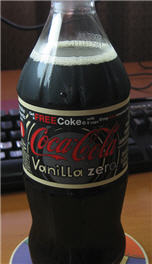
I’ve been a huge fan of Coke Zero for some time now. It’s a diet Coke — but unlike Diet Coke (which is New Coke with artificial sweeteners, which, since New Coke is all about the sweet is why it tastes like crap), Coke Zero is Classic Coke (with artificial sweeteners, but, damn, you don’t drink Coke for the sweet, so the artificial sweet isn’t nearly as obtrusive).
Now … Vanilla Coke Zero (or, more properly “Coca-Cola Vanilla Zero.” I loved Vanilla Coke back when I was drinking sugar-based sodas (and before it was discontinued last year). Margie spotted the new VCZ while shopping before my game Sunday and bought a 12-pack.
Aaaaaah. I love my wife.
VCZ is much as I remember Vanilla Coke — a bit sweeter and creamer than Coke, but with the Coke bite and a slurp of vanilla. It’s still not quite the same — yeah, it’s a diet product — but it’s still quite nice. (Not everyone agrees, but there’s no accounting for tastes, including mine).
Anyhow Coke is evidently relaunching Vanilla Coke again, as of this month, complete with a Zero version. Though, oddly enough, it’s not showing up at the company website.
I plan on keeping both Zeros in my drink fridge. Good times.
So maybe I will use the Feast Days to name these potpourri posts. There are plenty, and to spare (twenty-one others I could have chosen for today alone). Sure, they’re…
So maybe I will use the Feast Days to name these potpourri posts. There are plenty, and to spare (twenty-one others I could have chosen for today alone). Sure, they’re Catholic saints, but I tend to be Anglo-Catholic in my liturgical tastes, so I’m sure the Pope will forgive me.
So I like the fact that Al Gore’s office has papers semi-stacked all over the place in it. Now that’s a real office! Except … Dude, do you know…
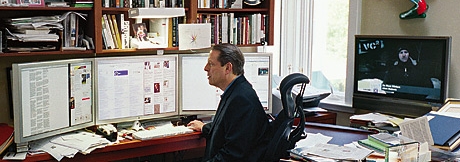
So I like the fact that Al Gore’s office has papers semi-stacked all over the place in it. Now that’s a real office! Except …
Dude, do you know how much electricity three widescreen monitors and a widescreen TV take? What’s that doing to your carbon balance?
(Al can feel free to donate one or two of the screens to me, of course.)