So, first off, amazing effort. Just stunning visualizations, some great acting, scenes that moved me to tears — just amazing. Also an amazing way to get all my classicist friends and relative fiercely debating interpretations, cuts, twists, bends, and perspective.
This review may have some spoilers (albeit for a movie about a thousands-years-old epic).
Story
Per the credits, the movie is “based on” Homer’s tale, and yes, this is not a ine–by-line rendition or translation. Things are left out. Things are put in. Things are changed.
But, then, that’s what everyone does. The Odyssey itself was an eventual writing down of many oral traditions, long after the story of Odysseus trying to get home from the Trojan Wars was first told, alongside countless other tales of other such journeys (or, in the case of Virgil’s Aeneid, the flight of the survivors of Troy to eventually found Rome). The question’s not, does Nolan give us a documentary of the journey, but are the ties to Homer’s tale and characters apparent, and does the resulting film stand up on its own.
And the answers here are, to my mind, a resounding yes. This is a retelling of the Odyssey for an early 21st Century audience. It’s not the only way the story could or should be told, but it has integrity and vision. This is Odysseus through the eyes of the last century of wars and homecomings, of the zeitgeist of changing (and perhaps failing) civil and social conventions, of the pitfalls and pains of leadership. It works for what it is trying to be. Those who want it to be something else are free to roll their own — I’m pretty sure the source material is public domain.
I’ve seen some folk refer to the film as a horror movie, and there are aspects of that, particularly in the nightmarish sense of danger and death during the long voyage. Some of the Bad Things that happen are the fault of Odysseus, or his crew. Some of them are just Bad Things, out of their control, but subjecting them to horrific consequences. That lack of control (even while feeling a sense of responsibility) is much of the drive for the protagonist, layered atop the guilt he feels for his actions in the Trojan War.
(That last part isn’t some modern revisionism, by the way. The Romans, who considered themselves descended from the Trojans, considered Ulysses/Odysseus a major villain. Dante puts him in his Inferno down amidst the Bad Advisors for his tricky plans and war crimes. Odysseus is, as Homer puts it in the opening lines, a complex / many-sided / shrewd / shifty / wily man.)
From a more meta level of looking at the story, there’s a weird tension in the movie between the presence of magic and the mythic (e.g., the cyclops) and the lack of overt interference by the gods themselves. The movie opens with the text, “It is a time of apparent magic,” an odd phrase that sets up that conflict, and it’s never quite resolved. Indeed, aside from Odysseus occasionally seeing and chatting with, Athena, the gods are present only by reference and assumptions of Bad Things Happening because of their displeasure. As far as that goes, it’s possible to see the movie as having no actual magic, save in the hallucinatory ramblings of a PTSD veteran — all the overtly magical things that happen during Odysseus’ trip home are being told recalled by him, still half-muddled by lotus-eating, to Calypso. Are they real? Or are they the nightmarish twists and turns of memory to explain away so much death? The viewer gets to decide, and I’m fine with that.
While the magic stuff gets all the focus when people talk about the Odyssey, much of the plot in both Homer and Nolan’s tellings are around the succession battles back home in Ithaca — young Telemachus, loyal Penelope, the dastardly suitors. Nolan smooths out some of the convolutions here to keep that plot in the center of things, and (believe it or not) tones down the violence that ends that particular conflict. We do get a bit too much Jason Bourne here in the final confrontation between Odysseus and the suitors, and the decision to make Antinous the suitors’ first among equals, and a particular slime bucket, feels a bit conventional (if understandable).
Though a 3-hour film, it didn’t feel that long by the time we got to the ending — where Nolan deviates the most from the original text, though in ways that suit modern film, especially if we’re going to avoid overt godliness. I won’t spoil it, but it combines a bit of the Nausicaa/oar tale with the (less pleasant) fate Dante improvised for Ulysses in his Divine Comedy, but with a sense of resolution and satisfaction that heroes in the original Greek tales rarely attain.
Production
Nolan’s willingness to spend a lot of time and money doing amazing things with practical effects and location shoots is widely known, and it both shows here and pays off. Are there computer-generated SFX here? Sure. But their use is limited (and marvelous); cyclopes are difficult to find these days, after all, and while we can appreciate visual tricks to avoid showing cyclops schlong, doing the same to avoid cyclops face would feel cheap and weird.
Instead, we get lots of shoots in lots of locations, and if something could be built (or borrowed), rather than rendered, Nolan did it. Yes, that’s actually a viking ship recreation — but it feels like it could be Odysseus boat. Yes, that’s Iceland, not Hades — but it’s creepifyingly glorious in its otherworldliness, and feels far more real than a lot of blue screen work.
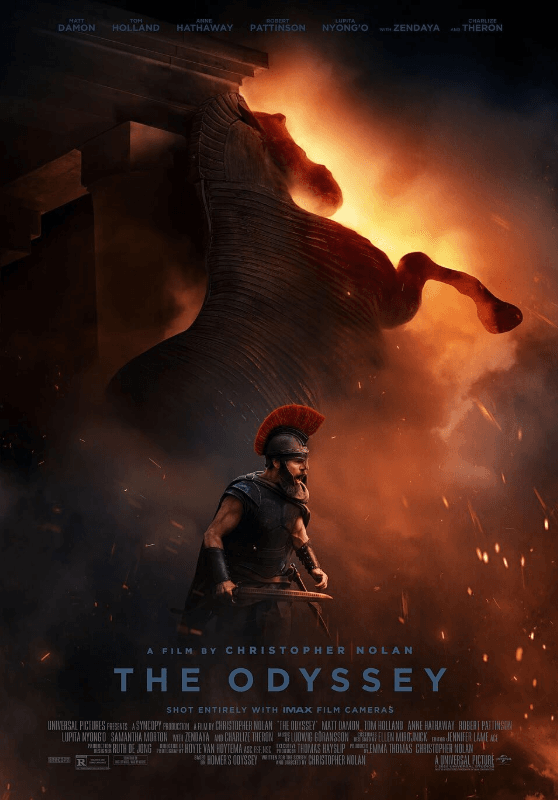
Kudos for a nifty re-envisioning of the Trojan horse. And, holy smokes, many topless towers of Illium were burned for this film.
And even when we get CG work, as noted, it’s for appropriately unearthly bits — the cyclops will be giving people nightmares for years (and change every rendition of such a creature forever). Scylla was delightfully uncanny. Even the oddly revised Laestrygonians look amazing in their activity.
Talking about production decisions brings to complaints made about historical accuracy. Well, sorry, this is not a documentary. It’s a 2026 movie based on a set of tales put in writing the 8th Century BC, and based on oral traditions about a war that happened in the 13th Century BC. The best we can hope for is verisimilitude in any “historic epic,” something that feels right and true as a backdrop for the story. If Matt Damon showed up in bright colors and wearing a boars-tooth helmet, the audience would laugh, even if that would have been more “accurate” for the period (or some period, at least).
(That said, some of the armor was … a bit sketch, enough to attract my attention as feeling off. That includes Agamemnon’s battle suit. That particular interpretation missed the mark for me.)
For folk complaining about “American accents” and language like “Dad” — it’s no less historical than having a bunch of Received English Shakespearean actors intone lines like the Bard wrote them — and the movie would probably not do well if it were scripted in Homeric Greek (or the earlier tongues that were present at the time the mythic events were supposedly set). The language and accents didn’t take me out of the film — it made the characters feel more real.
Acting
Overall, the cast does a solid job with what they are given. Matt Damon (Odysseus) gets the lion’s share here, as title character, and he ably carries the movie and the shifts of fortune for his character. He comes across well as driven, guilty, overwhelmed, dedicated, defiant. Good job. Tom Holland (Telemachus) is mostly hampered by what the role allows him to do and be beyond an impotently angry young man, uncertain how he can get Ithaca’s house in order, but he steps up to it admirably. Anne Hathaway (Penelope) is utterly believable in her whiplash shifts between loneliness, weariness, fury, and frustration. Robert Pattinson (Antinous) is a good enough sleazebag that sometimes he seems almost sincere, before demonstrating his sleaze. John Leguizamo (Eumaeus) gives us some great lines and the human side of how things are falling apart in kingless Ithaca. Samantha Morton (Circe) is creepy and dangerous and just a bit crazy, believably so.
Everyone else? They do just fine, too.
The topic, though, brings up two more areas of (in some cases, manufactured) controversy.
First, there have been plentiful complaints about the lack of actual Greeks in a film about a foundational Greek epic. I can understand that, though I’m pretty with the cast’s performance as it is, adding a token Greek actor would have been seen as tokenism, and making an all- or mostly-Greek cast would be getting us back in to the historicity debate (is it enough to have Greek faces? should they be speaking Greek? should they be speaking ancient Greek? how related are modern Greeks to the Achaeans of 3500 years ago? is the story about being Greek?). For that matter, if the argument is that the Odyssey is a cornerstone for Western Civilization, has it grown beyond being “just” a Greek story?
If this is meant to be a movie about Greek culture, it is not. But I don’t think that’s what it’s meant to be, or what I expected it to be.
The bigger (and nastier) argument has been around race, in particular the casting of Kenyan-Mexican actress Lupita Nyong’o as Helen (and her sister, Clytemnestra). An outrage, we are told! Helen wasn’t Black! Greeks weren’t Black! Homer mentions her as being blond! It’s woke tokenistic DEI casting!
I call bullshit.
First, arguing that Nolan as so incredibly “insensitive” as to shut out Greek actors from the casting, but so “woke” as to include a completely “inappropriate” Black actress as Helen seems contradictory. Get your stories straight, folks.
Second, yes, this is a movie, not a documentary. It’s a myth, not a history. The (mythic) Helen was hatched from an egg, fergoshsakes. Sure, the (mythic) Helen probably did not look like Nyong’o. The (mythic) Odysseus probably did not look like Damon. The (mythic) Telemachus probably did not look like Holland.
The key thing about Helen is not her hair color, or even her skin color. It’s her beauty. She is so strikingly beautiful that Paris is willing to risk war to kidnap her, and that Menelaus is willing to stir up a decade-long war and siege in order to get her back. She is literally (or literarily) the face that launched a thousand ships (and burned the topless towers of Ilium).
I find Nyong’o strikingly beautiful. Indeed, the skin tone contrast to most of the rest of the cast makes her even more striking. To that point, I find it perfectly appropriate casting, and am only sorry we don’t get to see more of her (in either role) during the film (though I understand why).
Her being Black does not alter the meaning of what Helen is and represents, in general or in this film.
Net-net
I had a great time seeing this movie in a theater (not IMAX, but good enough). The time flew. I don’t know how soon I’ll want to watch it a gain (it is an emotional kick in the gut more than once), but Nolan has created (or re-interpreted) something very special here. Bravo.
Do you want to know more?
(This is an expansion of my initial review on Letterboxd.)