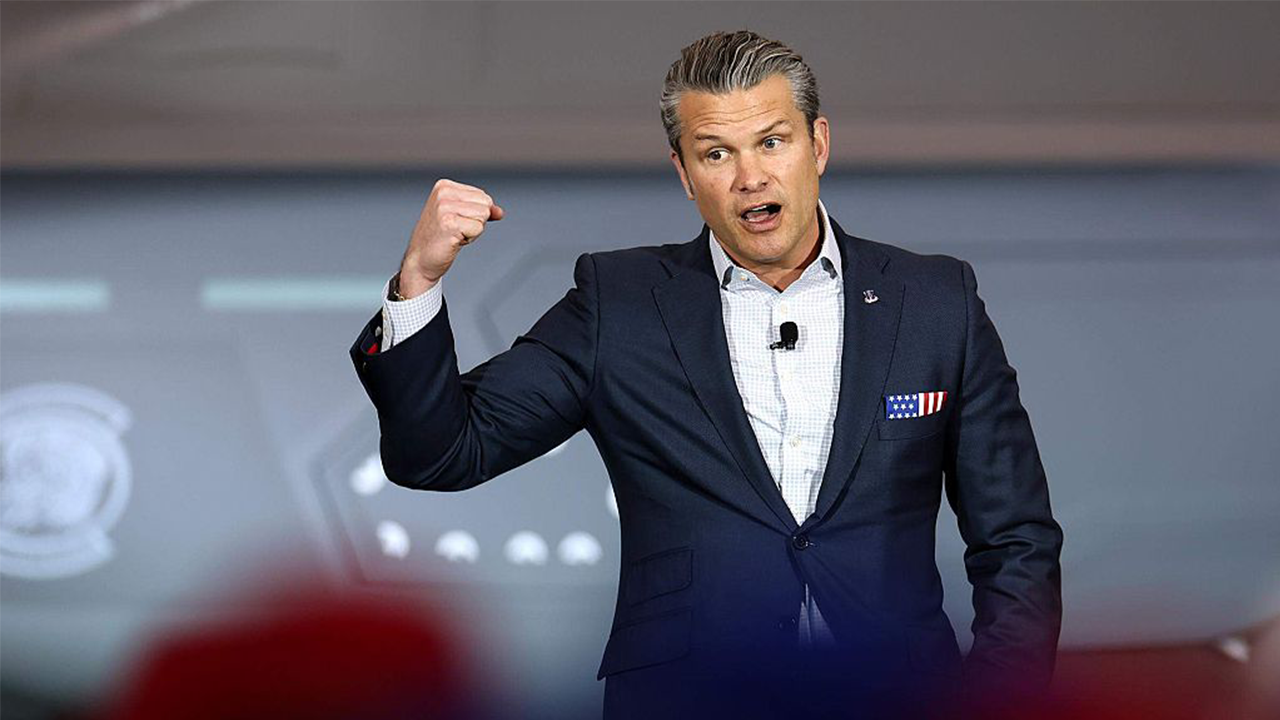
Defense Secretary Pete Hegseth yoinked top military leaders from around the world, at a cost of millions of dollars, for a short “pep talk” meeting at Quantico.
Trump, not wanting anyone to seem more important than he was, decided to come along so he could get a bunch of important people saluting him, because that’s like pure crack for a guy like him. We’ll circle back to him later.
But let’s look at Hegseth’s comments, as reported. This is the guy who runs the Defense Department (yes, the Congressionally mandated name is Defense, not War, no matter how many “Hi, My Department Is …” stickers Hegseth slaps on his suit coat).
(None of which has prevented him from changing both the website from defense.gov to war.gov, or the banner atop the website to read Department of War, of course. The Trump regime is always happy to skirt, or outright break, the law when it comes to pursuing its whims.)
The department’s mission is (still, officially):
To provide the military forces needed to deter war and protect the security of our country.
Which sounds pretty cool. Deterring war is good. Providing security is good.
Hegseth (along with, one presumes, his boss) doesn’t think that’s good enough. His rhetoric is nothing about protection, and even “security” tends to get short shrift. His person mission statements are full of words like “kill” and “violence” and “lethality”.
On the one hand, sure, being willing and able to kill, through violent and lethal means, is always a part of what the military does and should be able to do. But it’s the essence of the language here that feels important. It’s trying to be bad-ass. It’s trying to be macho. It’s trying to be, not the calm, assured, even friendly guy at the bar that you can tell you don’t want to mess with, or even the quiet one who exudes a sense of danger, but the loud, blustery, loud, yelling, bullying one who challenges anyone who looks at him cross-eyed and loves to shove folks around.
Sort of like Trump’s governing style, and just as buffoon-like.
Anyway, back to Hegseth’s How to Alienate Friends and Intimidate People seminar.

Let’s start from the top.
“We became ‘the woke department’,” Hegseth said in an address that seemed to designed to be as incendiary as possible. “Not any more. We’re done with that shit.”
For some folk, such as Trump, “woke” feels like a generic insult, a bit of political speech to target opponents with. Sure, it comes backed with more than a whiff of remembering the good ol’ days when it was okay to discriminate against women, Blacks, the disabled, people from other countries or religions, etc. without getting into trouble. But a lot of it feels like just trying to find a convenient label to hang onto the other side, like “tax and spend liberal” or “jacobite” were in the past.
Not Hegseth. He clearly projects a visceral loathing for what he terms to be “woke.” For him, that seems to mean any policy or philosophy that detracts from turning every member of the armed forces into a Robocop-like killing machine. He not only sees no value in diversity, he thinks it is a menace because it disrupts regimentation and makes his toy soldiers all look different. He can’t imagine a woman or a Black man or a Sikh being as good a violent, lethal, killer as he wants them to be, because his focus (as we will see) is as much on how they look as how they act.
Toy soldiers should all look and act the same.
Nor is diversity in thought to be encouraged; indeed, it’s to be stamped out. There is room for only the chain of command, with Pete up at the top (well, under Donald), and everyone below in lock-step obedience to orders. Concerns, dissent, differing opinions, counter-suggestions: all are a sign of weakness. Only obedience is of value.
“For too long, we’ve promoted too many uniform leaders for the wrong reasons – based on their race, based on gender quotas, based on historic so-called firsts,” said Hegseth, who fired Gen CQ Brown, an African American, as chair of the joint chiefs of staff in February, and has dispensed with the services of several high-ranking female personnel.
The shibboleth of quotas-mean-hiring-inferior-people is firmly fixed in Hegseth’s head. Having been in corporate America my entire career, and for a long patch as a hiring manager, I can confidently assert that diversity goals and encouragement in the hiring process was not about “Hire some women, no matter whether they are qualified,” but more “Why are all your applicants / hirees white guys — are you looking in an array of places, and are you discriminating in your processes?”
Hegseth says he wants promotions among “uniform leaders” to ignore race, gender, or any other factor than the factors he thinks are important. The thought that there might be value in having someone who doesn’t fit the traditional mold (white guys!) never enters his mind. Nor does he value any inspirational value such promotions might provide to others.
Nope. Anyone who doesn’t fit into the nice ranks of identical toy soldiers is clearly a “quota hire.”
Hegseth boasted of “remov[ing] the social justice, politically correct and toxic ideological garbage that had infected our department”.
He added: “No more identity months, DEI offices, dudes in dresses. No more climate change worship, no more division, distraction or gender delusions, no more debris.”
Not surprisingly, “climate change” is dismissed as garbage. So much for deterrence of war or protection of national security in the face of the economic and population disruptions already occurring due to climate change. I have no idea whether Hegseth actually knows anything about climate change, only that it’s part of “politically correct and toxic ideological garbage” that has “infected” the DoD.
Purity — that’s what’s important. No “garbage.” No “toxicity” (hold that thought). No “delusions.” No “debris.” Everything clean and tidy and orderly and fitting some mythic Pattonesque vision of conformity and unity, with the sole focus on killing the other guy better and faster and more thoroughly.
Also not surprisingly, Hegeseth considers gender issues a “delusion” (to be dismissed with the oh-so-un-macho disdain for “dudes in dresses”). Nor is any “identity” of value to him other than identity as “lean, mean, killing machines.”
“Fat troops are tiring to look at,” Hegseth said, as he ordered commanders to crack down on a lack of physical fitness. “It’s tiring to look out at combat formations, or really any formation, and see fat troops.”
There’s this ongoing weird note of personal disgust for things that take away from what Hegseth considers the real mission of the DoD. “Fat” troops are “tiring.” Not “sub-optimal” or “concerning” or “not the best that we can be,” but an insulting “tiring.”
Hegseth is apparently a big believer in sauce for the goose is sauce for the gander, though:
Commanders were not excepted from Hegseth’s purge on the overweight. He lamented having to see “fat generals and admirals in the halls of the Pentagon, and leading commands around the country and the world”.
On the one hand, this seems fair, right? If we don’t want “fat” troops, then leading by example is important. Never mind that other “leading by example” considerations are disdained by Hegseth as quote hires and the like. The war on fat soldiers is mission-critical.
But once you get beyond seeing “fat” generals as (one presumes) “tiring,” so what? Unless you expect those generals to be out there digging trenches and charging the enemy and needing to do 250 pull-ups for some mission, what’s the value here? Performative slimming?
And what about the Commander-in-Chief? Is it “tiring” seeing his weight issues? Since I don’t expect Trump to lead the charge up San Juan Hill, I don’t see that as an issue. But I don’t expect that of anyone of general or admiral rank, or even much below.
I don’t have a problem per se with a lean, fit military (even if a lot of military jobs have little to do with actual combat). But forcing a lean, fit military because someone finds it “tiring” to see overweight soldiers seems a bit weird. It feels more like pushing for how folk look than how they are called to act.
It also raises concerns about what standards are necessary, and what standards are used as weapons.
“Would you want [your child] serving with fat or unfit or undertrained troops? Or alongside people who can’t make basic standards? Or in a unit where standards were lowered so certain types of troops could make it in? In a unit where leaders were promoted for reasons other than merit, performance and war-fighting? The answer’s not just no, it’s hell no.”
Ah. We pivot from “fat” being a problem to “basic standards” being lowered and promotions being given for folk who are unworthy — worthiness being defined by meeting those basic standards.
Which means those standards can be weaponized. Don’t like women in combat — or in the military at all? Keep raising physical standards — regardless of what they need to be — so that you can exclude most women (to the degree that women’s average upper body strength, what is usually being tested, tends to be lower than men’s average upper body strength). Then when you have a much smaller number of women in the military, you can complain about how it’s operationally disruptive to meet all their different needs, and so you have no choice but to exclude them from combat roles, or (since everyone is now no longer allowed to be “fat,” which means that everyone is expected to be able to be in combat), maybe all roles whatsoever.
The first question is not whether a given person can meet a particular standard. The first question is, what does the standard actually need to be?
The same is true for that statement about promotions being given out for “reasons other than merit, performance and war-fighting.” What are the standards for meriting a promotion? What performance standards and areas are you talking about? What constitutes promotion standards for war-fighting? And are you crafting those standards towards the mission? Or to other, exclusionary ends, to create a military that looks like some ideal you’re carrying around in your head?
“No more beards, long hair, superficial individual expression,” the clean-shaven war secretary declared. “We’re going to cut our hair, shave our beards and adhere to standards.”
“We don’t have a military full of Nordic pagans, but unfortunately, we have had leaders who either refuse to call BS and enforce standards or leaders who felt like they were not allowed to enforce standards.
“The era of unprofessional appearance is over,” he declared. “No more beardos.”
To hear Hegseth talk, you’d think that grooming standards have been non-existent, that there’s been some outbreak of soldiery with long beards, pony-tails, and dirty fingernails. Certainly it sounds like our national security is being threatened by (to use Hegseth’s disdainful terms) “superficial individual expression” and “unprofessional appearance” and “beardos.”
This is where we get into that tin-pot general marching around toy soldiers concept again. Because Hegseth has made it clear that not adhering to even more strict grooming standards is somehow damaging to our “war-fighting” ability.
How?
I mean, I haven’t heard anyone saying, “well, if you have a beard, then the beard hairs can get caught in your M250 machine gun and jam it.” Or “If your hair extends over your ears then you can’t properly wear headphones while piloting your chopper” or anything like that.
Nope. It just looks “unprofessional,” all for the sake of “superficial individual expression.” Because individual expression is a menace, even if we dismiss it as “superficial.” It somehow violates the “warrior ethos” (whatever that is), harms discipline, and reduces the ability to effectively war-fight.
Somehow.
The military is always leaning on uniformity (heck, they wear uniforms), but it’s also something that rightfully gets poked fun at when taken to extremes. While having soldiers out in the field wearing jeans and personal t-shirts has some clear problems, having a bit longer hair, or a beard, or some other “superficial individual expression” does nothing to affect the ability to point a gun and shoot it. Nor does it arguably make soldiers less likely to obey orders or have each others’ backs, or love their country.
But it does make the troops look somehow sloppy, and, if your focus is on the optics of being ultra-lethal, ultra-violent, ultra-war-fightable, then utter uniformity is a great way to impress people while on parade. The Soviets knew that. The Germans knew that. Every army that puts on a big parade for their leaders knows that.
If your focus is on the optics.
It’s also useful if you have an ideal as to what a soldier should look like. The problem being, that’s a great way to incorporate personal, idiosyncratic standards. Soldiers should be this tall. Their hair should be this long. Their cheeks should be this smooth. And maybe their skin should be this color. And their external plumbing should be this configuration.
I mean, hair length standards are arbitrary, based on personal taste or prejudice. Why not other prejudices?
Especially when demanding clean-cut faces has its greatest impact on Black male soldiers who are more likely (60% of the population) than white ones to suffer from PFB, which causes painful ingrown hairs when going clean-shaven. Military policy has been to allow medical waivers to allow neat but present beards where needed. New military policy, disdainfully articulated by Hegseth at this meeting, is to kick people out of the military if they need such waivers for over a year. Sure, that means its more likely you’re kicking out Black soldiers than white soldiers, and for something that has no connection to merit, performance, or war-fighting … but does have something with what kind of faces you want to see in the ranks.
Besides, worrying about whether a policy affects Blacks more than whites is “woke,” amirite?
The first of Hegseth’s 10 Department of War directives seemed to make it explicit that he viewed the military as a man’s world. “[E]ach service will ensure that every requirement for every combat [member of service] for every designated combat arms position returns to the highest male standard only,” he said.
Not “the” or “a single” standard. The “male” standard. No discussion of whether that standard is proper or at the needed level. The important part is the “male” standard.
But this is not meant to exclude women. Kind of, anyway:
“This is not about preventing women from serving,” he said “We very much value the impact of female troops. Our female officers and NCOs are the absolute best in the world. But when it comes to any job that requires physical power to perform in combat, those physical standards must be high and gender-neutral.
“If women can make it, excellent. If not, it is what it is. If that means no women qualify for some combat jobs, so be it. That is not the intent, but it could be the result, so be it … We’re not playing games. This is combat. This is life or death.”
And if you set the bar high enough, you can get rid of all the slimy girls and avoid the girl cooties and make your toy soldiers look even more uniform. Win-win!
All of this, never minding, that Black and female enlistments to the military have been growing in proportion to white male enlistments. Or that the military has been having problems recruiting as many people as they want in the first place. Let’s come up with policies that we know will impact those populations (but not actually improve war-fighting capacity) so that they leave or are kicked out. That’s the ticket.
But, again, we shouldn’t worry about that, because worrying about how a policy (meaningful or not) impacts women vs. men is “woke,” and we shan’t have any of that around here.
“Leading war fighters toward the goals of high, gender-neutral and uncompromising standards in order to forge a cohesive, formidable and lethal Department of War is not toxic,” he said, complaining that words like “bullying”, “hazing” and “toxic” had been “weaponised and bastardised” and had had the effect of undermining commanders’ authority.
“That’s why today at my direction, we’re undertaking a full review of the department’s definitions of so-called toxic leadership, bullying, and hazing to empower leaders to enforce standards without fear of retribution or second-guessing.”
I.e., officers and NCOs are tired of being punished for making sexist remarks about female “war-fighters,” or allowing or engaging in abuse of recruits and active serving military in order to “toughen them up,” so we’re going to stop doing that.
I’m sure that will improve recruitment, too.
But that’s part of this whole idea of being macho as the attitude necessary for having the best “war-fighters.” Yelling, bullying, hazing, being toxic — that’s what the current civilian leadership is, pretending to be alpha male bundles of testosterone, so that’s what military leadership should be even more. After all, everyone loves the scenes where Drill Instructors yell at recruits and make them do degrading tasks because that’s the only way to break them (“spare the rod and spoil the child”). If we can’t break them, then how can we send them into US cities to break up protest marches? How can we look at the camera and menacingly tell our “enemies” (whoever they are today) “FOFA” in a manner that elicits more laughter than fear.
“The sooner we have the right people, the sooner we can advance the right policies. But if the words I’m speaking today are making your heart sink, then you should do the honorable thing and resign,” he said. “We will thank you for your service.”
Which sounds more like the talk you give to employees after a hostile takeover, not what you say to all of your top general officers across your military. Dissent is dishonorable, apparently. But “respect” is also a word foreign to the Trump regime.
So, welcome to your new military, when crafting toy soldiers who look good takes priority over effective leadership (unless it’s leadership that is effecting the new policies); where diversity is a dirty word and policies that discriminate are ignored because of standards designed to discriminate; and where anyone who doesn’t like it is dishonorable, woke, or otherwise unfit.
Good luck, Pete, with providing the military forces needed to deter war and protect the security of our country. But I’m sure they’ll look good parading in front of reviewing stands for the President.
UPDATE: I said I would circle back to Trump’s performance there, what it was of it. After a slow ramble (tiring!) to the stage, he gave a slow, rambling address as well, complaining about ugly ships in the US Navy (and how “we should maybe start thinking about battleships”). He complained about Joe Biden and auto-pens. He complained about not getting a Nobel Peace Prize (yet).
But, good news, of course: he also mentioned how US cities would make great “training ground” for troops, because we are “under invasion from within.”
He encouraged the audience of all the top brass to applaud him and cheer at what he was saying (they didn’t, because that’s the tradition; the military shouldn’t be cheering for or booing against the civilian leadership).
It was truly inspiring.